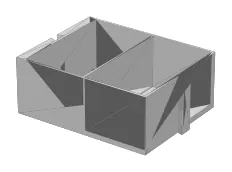
Modular Desk Organizer Tray
Pen tray and dividers. Box-shaped units that connect side by side.
Desk items for organizing pens, sticky notes and more. 15 items
Pen tray and dividers. Box-shaped units that connect side by side.
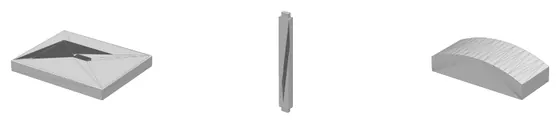
For people who want to hang headphones on a desk. Three parts, the base, the post, and the rest, are assembled by pushing square tenons together, and the headband sits on the rest. The post is about 200 mm, and it is designed to come apart without glue.
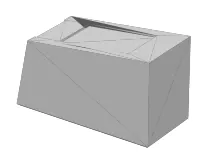
Feet for people who want to raise the front of the keyboard slightly to adjust wrist angle. They are wedge-shaped, and changing the orientation of the bottom face switches between two steps, about 6 degrees and about 12 degrees. The same shape is printed twice, and the top has a recess for a non-slip sheet.
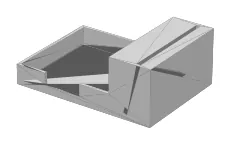
For desks where you want sticky notes and memos together within reach. A shallow box holds a stack of sticky notes, and memos stand tilted at about 15 degrees in the slotted tower beside it. The box and tower are one piece, so you can set it on the edge of a desk without assembly.
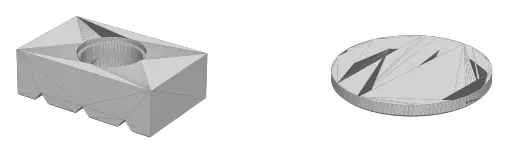
For people whose cables keep falling off the edge of the desk. Put coins or washers in the cavity in the base and close the lid, and the weight is meant to keep the body in place on the desk. Cables pass through three grooves on the top and are designed to line up in position. It suits a waiting spot for charging cables.
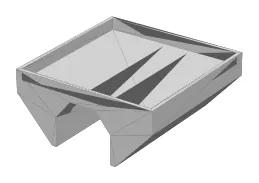
A bridge-shaped tray for people who have free space around the monitor feet but nowhere for small items. The tunnel underneath straddles the monitor foot, and you can put keys and pens in the shallow tray on the roof. The rim is low, and the shape is meant to make it harder for items to slide off.
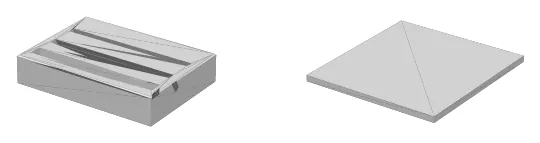
For people who want to prop up a tablet while watching videos or following recipes. Moving the back plate to one of two slanted grooves changes the angle in two steps. The groove at the front works for both portrait and landscape, and it is assembled from two parts, the base and the back plate.
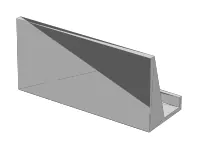
For people who want to display business cards on a reception or meeting desk. Cards lean against a slanted face, and a low lip at the front catches the lower edge. Dimensions are based on a card size of about 91 x 55 mm, with about 10 mm of extra room for thickness.
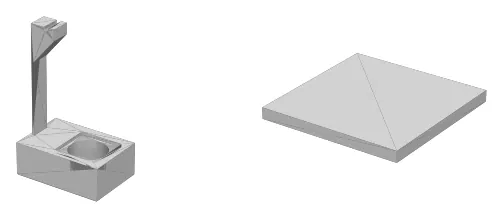
For people whose mouse cord catches on the edge of the desk and makes the mouse hard to move. Put coins in the base and close the lid to make a weight, and the cord is lifted by an arm made of a standing spring plate. Just hang the cord in the groove at the tip of the arm. It has two parts, the base and the lid, and assembly needs no tools.
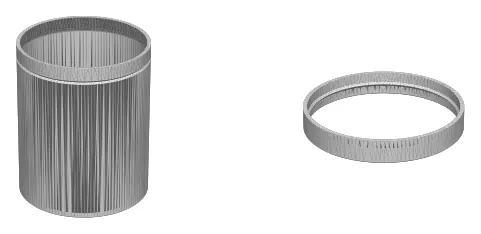
A bin for people who want to catch eraser crumbs and paper scraps on the desk. Fold the mouth of a small store-bought bag over the top of the tube and press it down with the ring. Ridges on the inside of the ring fit into V-grooves on the tube. It has two parts, the tube and the ring.
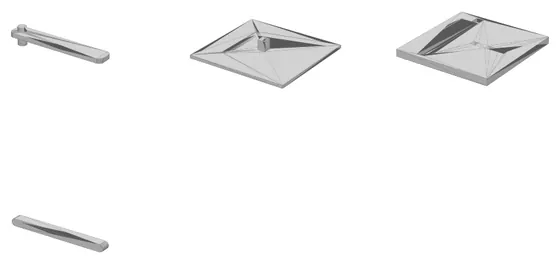
For people who want to read a book or recipe book standing open. Moving the legs to one of the three pockets in the base changes the tilt of the back plate in three steps: about 10, 20, and 30 degrees. Two rotating arms hold the pages down, and it is made of three parts.
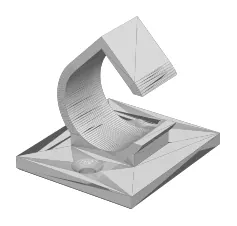
For people who want to gather power strips and wiring hanging under a desk onto the underside of the top. Attach the C-shaped hook to the underside with two wood screws, and push the bundle of cables in from the side opening. The same piece is printed twice and the two are used side by side.
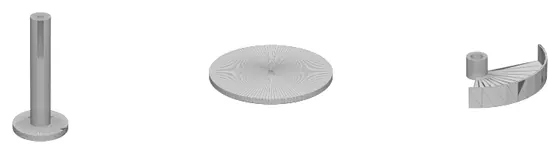
For people who want to keep small items such as clips and seals separated without using much space. Three fan-shaped trays are threaded on a single shaft, and turning them opens them like a fan. The shaft is screwed in from below the base with a store-bought wood screw, and the same tray is printed three times.
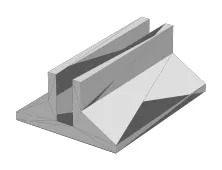
Feet for people who want to stand a store-bought board on a desk to divide their workspace. The edge of the board slips into the groove, and one foot is used at each end of the board. The groove gap can be adjusted with a parameter, based on a board thickness of about 9 mm, and the same piece is printed twice.
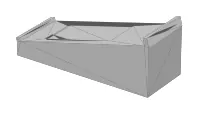
For people who want to raise the back of a laptop so the screen is easier to see. The wedge shape is about 8 mm at the front and about 28 mm at the back, with a recess on top for non-slip material and a lip at the front and back. The same piece is printed twice, for left and right.